Page 6 of 17
Posted: Wed Jan 24, 2007 5:40 am
by Digit
If I understand this discussion correctly I have to accept that, if I were to teach a small, non-literate society, 'Mary had a little Lamb etc', then to return some thousands of years later, I should find that the now literate society, along with the rest of the world, after many years of oral transmission, plus translations and translation of those translation would repeat the rhyme to me word perfect?
I find that very difficult to accept.
Complaints against the veracity of the Bible, for example, often focus on inaccuracies contained within, my comments above duly apply, if it were not so I would have to suspect that it was first written after the invention of the printing press.
Translations are usually translations of the meaning, and thus open to the translaters interpretation, which means they must be intimately familiar with the daily use of the original language, something that can be difficult where, for example, the original text contains no vowels.
This is the name of a village in Wales, the usuall translation you can look up yourselves;
Llanfairwllgyllgogerychwymdrobwllllantysiliogogogoch;
and before someone corrects my spelling the Welsh haven't settled that yet either and a word by word translation is as indecipherable to us English as is the Welsh, the usuall translation is of the meaning, which is a set of directions to find the place.
Posted: Wed Jan 24, 2007 6:15 am
by Beagle
Now bow down and worship Marduk, the reincarnated Babylonian.
Arch has nothing on Marduk, when it comes to weird.
Posted: Wed Jan 24, 2007 6:23 am
by Charlie Hatchett
Arch has nothing on Marduk, when it comes to weird.

... Never met Arch, but it would take quite the character to top Marduk.
I say that in a loving way.

Posted: Wed Jan 24, 2007 6:24 am
by Charlie Hatchett
By the way, I love your quote by Edison:
Hell, there are no rules here - we're trying to accomplish something.
Thomas Edison
Classic!

Posted: Wed Jan 24, 2007 6:26 am
by Beagle
Thanks Charlie

Posted: Wed Jan 24, 2007 7:46 am
by marduk
Arch has nothing on Marduk, when it comes to weird.
from anyone else that would be an insult
but considering its you Beagle
its a huge compliment
thankyou very much

Posted: Wed Jan 24, 2007 9:55 am
by Minimalist
I should find that the now literate society, along with the rest of the world, after many years of oral transmission, plus translations and translation of those translation would repeat the rhyme to me word perfect?
What about if your "acceptance" were enforced by burning you at the stake if you argued about it?
Posted: Wed Jan 24, 2007 11:06 am
by Digit
On the basis that I wouldn't expect such action to be world wide I think my comment still holds. I can't believe that oral tradition or translations can remain word perfect over long time scales, I certainly don't know of any examples do you?
Posted: Wed Jan 24, 2007 11:11 am
by Forum Monk
Digit wrote:On the basis that I wouldn't expect such action to be world wide I think my comment still holds. I can't believe that oral tradition or translations can remain word perfect over long time scales, I certainly don't know of any examples do you?
Think about it. How would you know?

Posted: Wed Jan 24, 2007 11:25 am
by Minimalist
Digit wrote:On the basis that I wouldn't expect such action to be world wide I think my comment still holds. I can't believe that oral tradition or translations can remain word perfect over long time scales, I certainly don't know of any examples do you?
Wait a minute. If everytime the nursery rhyme is changed and the person who protests that it was changed is burned at the stake, then the new, revised, nursery rhyme becomes dogma. Until the cycle repeats.
There are lots of world wide myths, not only the flood (although Hancock chose to concentrate on that one.)
There are also far-flung myths of a Golden Age and a War in the Heavens, (Von Daniken liked that one.)
Posted: Wed Jan 24, 2007 11:39 am
by Digit
Put it this way Monk, I was hoping someone would give me an example and then I was going ask how they knew. What you say Min is probably true, but I doubt that every society would go to that extreme for non-religious stories.
I still think that 'Chinese Whispers' will apply to constant repetition over long time scales whether we can prove it or not. Earlier it was suggested that flood legends had a common root, if they do, then with the passage of time, and the necessary translations, I would expect significant variations in the telling.
Posted: Wed Jan 24, 2007 11:42 am
by Charlie Hatchett
I was doing a little research today, and ran across a reconstruction of Leanne, the Paleo woman buried at Wilson-Leonard, in central Texas
:
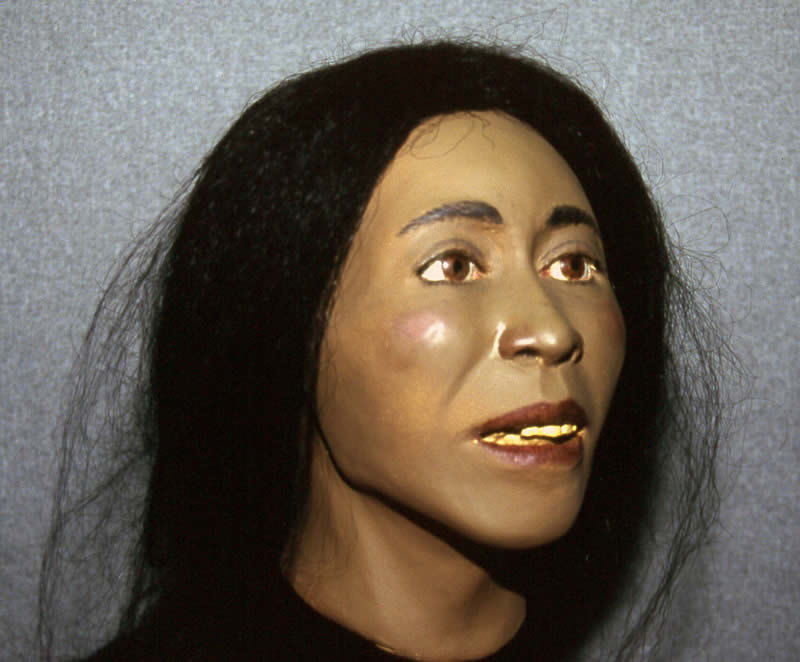
Does anyone remember what thread we had the Bosque Man posted under.

I wanted to try to keep them together.
Posted: Wed Jan 24, 2007 12:11 pm
by Minimalist
I ran a search for Bosque and came up with these 3.
Discussion Forum Early American Indians
Discussion Forum PreClovis Iron Smelting in Texas
Discussion Forum Pre-Columbian settlement.
Posted: Wed Jan 24, 2007 12:14 pm
by Minimalist
Earlier it was suggested that flood legends had a common root, if they do, then with the passage of time, and the necessary translations, I would expect significant variations in the telling.
I guess you'd have to define "significant," Digit. In many of these tales the common symbol is the flood itself and there are numerous regional differences in the rest of the story.
Not all of them have an Ark.
Posted: Wed Jan 24, 2007 12:43 pm
by Digit
People tailor these stories to fit their audience, names are changed because the original is foreign sounding or dificult to pronounce.
Take Cinderella, in the French 'orignal?' versions we have a fur slipper, one translational error and it has become a glass slipper.
Take Alladin, originally Allah Din, the name has been corrupted in a meaningless name.
When King Charles the 2nd first entered St Paul's cathedral he described it as 'awful', he meant he was filled with awe, how, I wonder would a French translator today handle that?
Take the word 'peculiar', originally it meant pertaining to, how would a translator of a 19th C book translate that?
Describe a woman as sophiscated and she will likely smile, a few years ago you would be spitting teeth, as it originally meant a prostitute.
Translate these examples a number of times and the meaning would likely be lost.
The Bible states, 'In the beginning the word was with God and God was the word', I once challanged a Christian fundamentalist who based his beliefs on the literal word of the Bible to explain to me what that meant.
He hadn't got a clue, it does make sense in its original context though.