What is it that you think you have there? Do you have a working hypothesis on it? You know me. I don't require absolute 'proof' but you must have some thoughts about the nature of the location?
The geologists studying the site are guessing the artifacts unraveling out the alluvial gravels might be from the Sangamonian Interglacial. Here's one of the geologist's take:
...Charlie found one in situ stemmed projectile point in the gravel cap underlying (older than) fine-grained sediments in which Clovis points have been found by others and dated by them at ca. 12,000 years. Said tool (stemmed 20) has remnants of a carbonate coat covering the flake scars. (flake scars = tool shaping = older than carbonate coat = older than gravel cap = older than Clovis = older than 12,000 years). Other stemmed tools from nearby float (out of context) also have remnants of carbonate coats covering flake scars, as do many other float specimens showing various flaking technologies. He finds other artifacts in the overlying fine-grained sediments, the ones that have produced Clovis points at a nearby site, but none of them have remnants of a carbonate coat. We can assume they are younger than the carbonate coat episode.
But carbonate coats don't start out as relatively thick spots on flake scars; they start out as thin films covering the whole piece and thicken slowly over time. And nature doesn't treat an artifact as an artifact; she treats it as a piece of gravel. So we can further assume that, after these pieces were made, they rested a long time in the place they were dropped, and that the climate at that time was hot and dry, with intermittent moisture (for the carbonate to be moved in solution and later deposited on the tools. Sangamonian Interglacial?) Then the climate got a lot wetter (Wisconsin time?) This in order to erode the sediments containing the tools, concentrate them, and move them along in a relatively high energy environment to their current position in the gravel cap, knocking off most of their carbonate coats in the process.
So, these tools Charlie is finding will have to be older than the gravel cap out of which they are now eroding. And they can be of various ages. Two especially, if those chip marks aren't natural, have had flake scars modified by water transport, i.e. dulled edges, before the carbonate coat was added (paleo 20, photo 2010a; preclovis 2019). Others may have been recycled at a later date (preclovis 20190, preclovis 20206)...
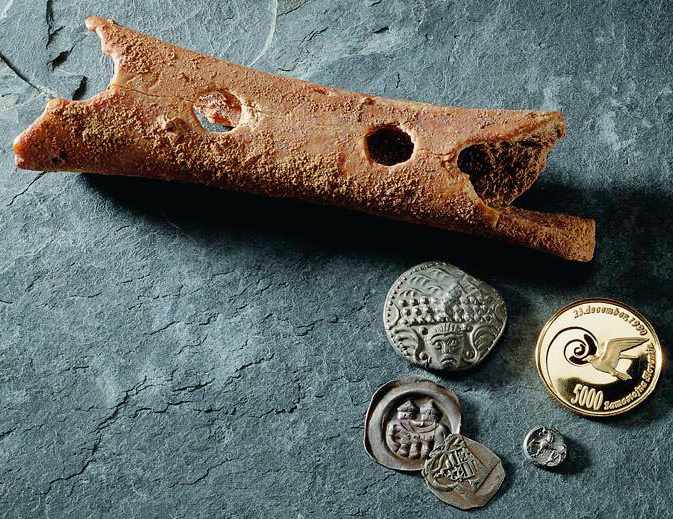
Makes me wonder more about the flute, and it's possible connection to the Mousterian Tradition. The supposed "last stand" of the Neanderthals was at Gibraltar...then they mysteriously disappear.
Now, if these guys could make fine art, bone flutes, etc...is it too much of a leap to say they could have built simple boats?
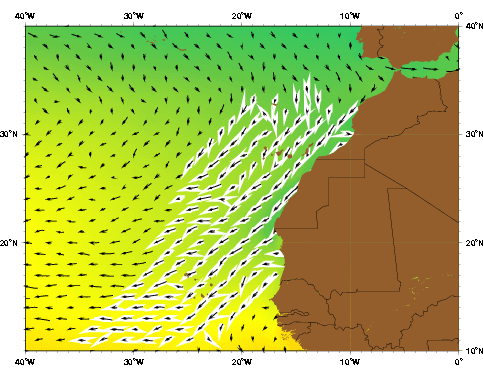


With a simple sail or, perhaps, paddling, they could have made the trip, chasing marine life, in ca. 6-10 days. The Canary Current and prevailing, steady, quite strong Easterly winds would have made the trip much easier and faster.
That's one hypothesis I'm working on...
Current local radar:

Another busy day of salvage tomorrow...bitter-sweet...