http://www.beforebc.de/600_fareast/03-16-600-00-08.html
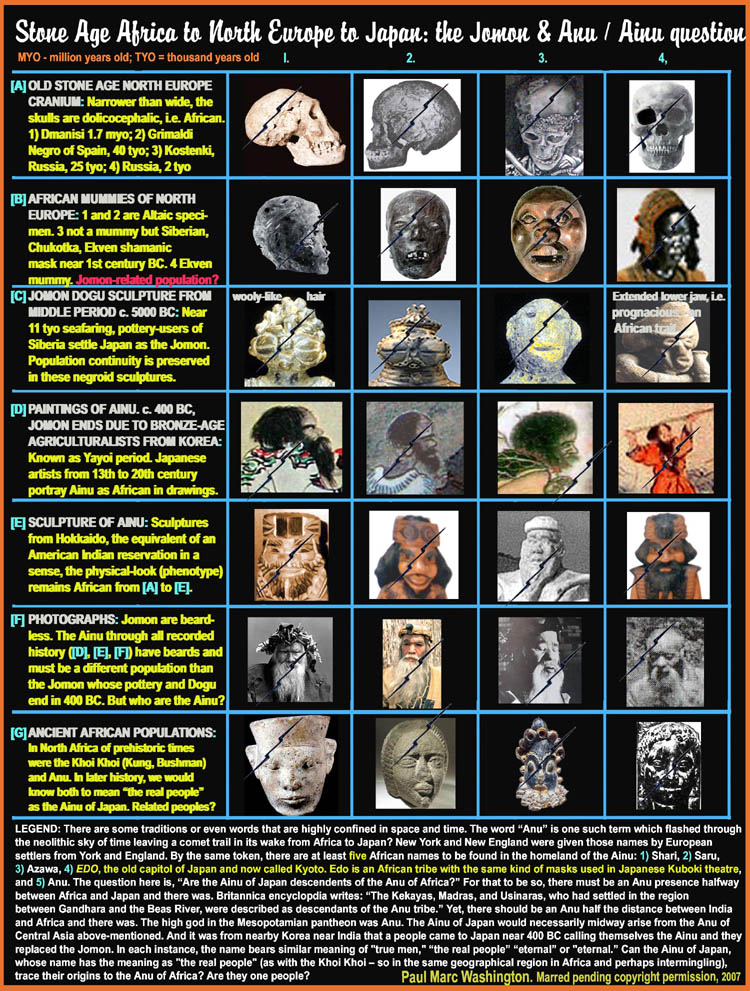
The lower legend reads:
LEGEND: There are some traditions or even words that are highly confined in space and time. The word “Anu” is one such term which flashed through the neolithic sky of time leaving a comet trail in its wake from Africa to Japan? New York and New England were given those names by European settlers from York and England.
By the same token, there are at least five African names to be found in the homeland of the Ainu: 1) Shari, 2) Saru, 3) Azawa, 4) EDO, the old capitol of Japan and now called Kyoto. Edo is an African tribe with the same kind of masks used in Japanese Kuboki theatre, and 5) Anu. The question here is, “Are the Ainu of Japan descendents of the Anu of Africa?”
For that to be so, there must be an Anu presence halfway between Africa and Japan and there was. Britannica encyclopdia writes: “The Kekayas, Madras, and Usinaras, who had settled in the region between Gandhara and the Beas River, were described as descendants of the Anu tribe.” Yet, there should be an Anu half the distance between India and Africa and there was. The high god in the Mesopotamian pantheon was Anu. The Ainu of Japan would necessarily midway arise from the Anu of Central Asia above-mentioned. And it was from nearby Korea near India that a people came to Japan near 400 BC calling themselves the Ainu and they replaced the Jomon.
In each instance, the name bears similar meaning of "true men," “the real people” “eternal” or "eternal.” Can the Ainu of Japan, whose name has the meaning as "the real people" (as with the Khoi Khoi – so in the same geographical region in Africa and perhaps intermingling), trace their origins to the Anu of Africa? Are they one people?


 I must say, that your use of the term dolicephalic is inaccurate, except in the case of Dmanasi. Regional adaptations were well in place by 400,000 yrs. ago, where mesocephalic and brachycephalic morphology was apparent. Those terms are just not used any more.